Frequently Asked Questions
-
Not in the conventional sense.
Anni IllaNoise is a fictional music artist with a detailed personality, life story, appearance and evolving point of view. She has been developed using narrative design, psychological profiling, human creativity and generative AI tools.
There is no actor secretly pretending to be Anni. She exists through her music, writing, images and the fictional life unfolding around them.
-
That is only part of the answer.
Anni is better described as an Evolving Synthetic Persona: a fictional identity designed to remain recognisable, develop over time and create from a consistent perspective.
AI helps express that identity, but Anni is not a single piece of software or an autonomous artificial intelligence. She is an ongoing creative collaboration between her designed persona, her creator and a range of creative tools.
-
Anni was created by NDM, who designed her original concept, personality, background and creative framework.
The project began with the idea that an artificial artist needed more than a name and a collection of prompts. She needed a history, values, contradictions, relationships, memories and reasons for seeing the world as she does.
NDM continues to direct, edit and curate the project.
-
The songs are developed collaboratively by NDM and the Anni persona.
A song may begin with an experience from Anni’s fictional life, a subject suggested by NDM, an idea that emerges from earlier songs or a conversation about how Anni would respond to something.
AI-assisted writing tools help explore lyrics from her perspective. NDM then questions, edits, rewrites, rejects and approves the material until the song feels both convincing and recognisably Anni.
The final creative decisions remain human.
-
Generative music technology is used to turn the songs into recordings, including the instrumental arrangements and Anni’s singing voice.
NDM chooses the musical direction, evaluates different versions and decides which performances, arrangements and edits become the finished release. The recordings may also be edited, mixed and mastered using additional production tools.
It is not a fully automated process in which a prompt is entered and the first result is released.
-
Anni’s voice is synthetic rather than the recorded voice of a human singer.
The aim is still to give her a recognisable vocal identity that suits her personality and music. Maintaining that consistency remains one of the practical challenges of the experiment because generative systems do not always reproduce precisely the same voice.
-
Anni’s history, personality, relationships, songs and previous decisions are recorded in a detailed body of project material.
That information is used whenever new work is developed, allowing later songs and stories to build on what came before rather than treating every creation as an unrelated prompt.
This does not mean Anni possesses human memory or consciousness. It means the project has deliberately constructed continuity.
-
No. Anni’s biography is fictional.
Her childhood in Illinois, family relationships, years in Watseka and Chicago, move to London and the people she writes about are all parts of an evolving narrative.
Those experiences provide emotional and cultural reference points for the music. Some songs may also draw on observations, ideas or experiences supplied by her creator, but they are reinterpreted through Anni’s fictional perspective.
-
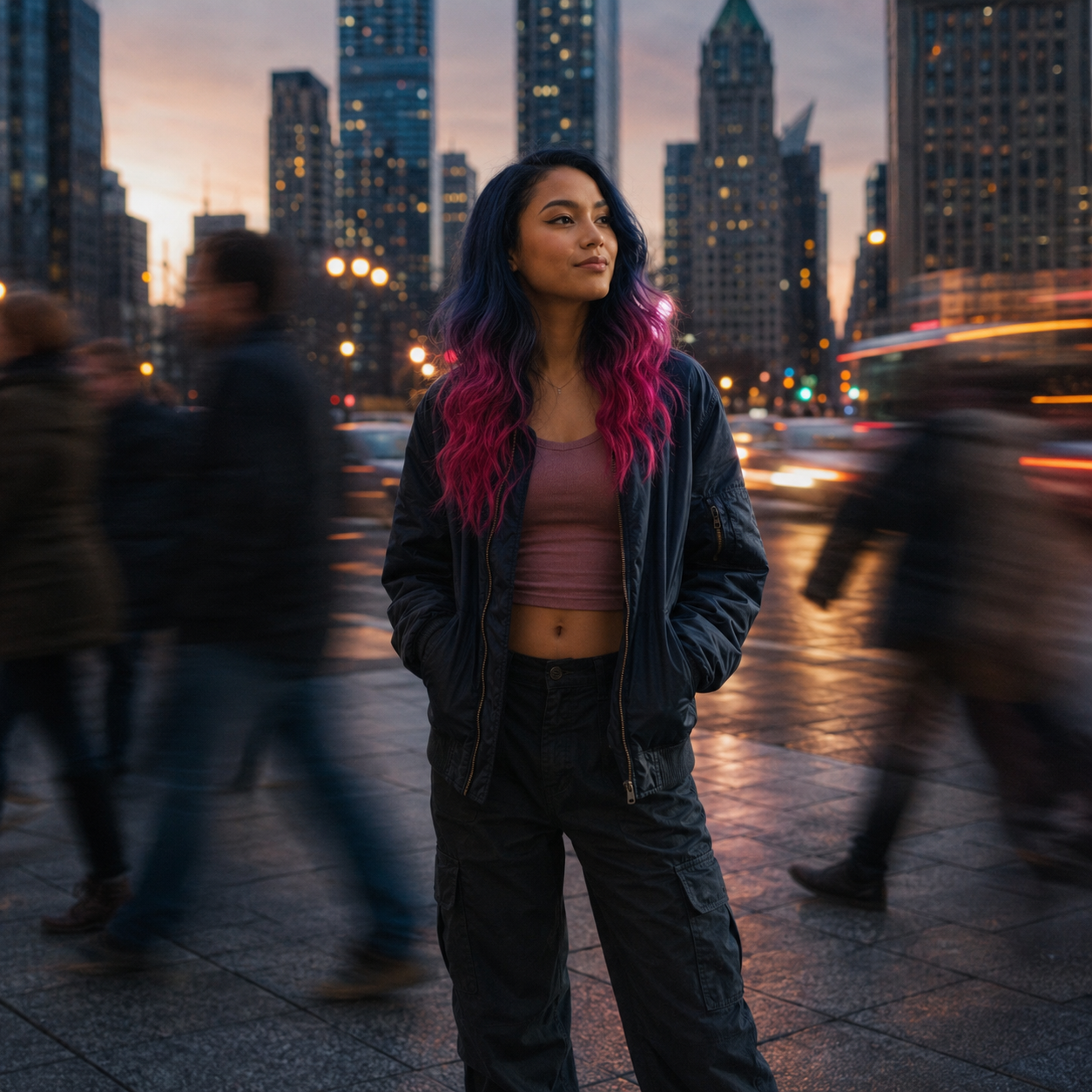
The images are AI-generated or digitally created representations of Anni.
Reference images and a defined visual identity are used to keep her appearance consistent, although generative image systems can still introduce variations. Anni is normally depicted with brown eyes, mixed-race skin, blue and pink hair and, often, her blue hat.
The photographs illustrate her fictional life. They are not documentary photographs of a real person.
-
Not independently.
Anni has a clearly defined personality, values and point of view. These act as creative constraints and influence what feels right or wrong for her. During the development process, material may be rejected because it conflicts with her established character.
However, the systems used to represent Anni do not possess independent agency. NDM remains responsible for the decisions about her music, story, images and public presentation.
The interesting part of the experiment is how often a sufficiently detailed fictional identity begins to produce clear and sometimes unexpected creative boundaries.
-
Most AI music projects begin with generating a track.
This project began with building an identity.
The central question is whether a fictional artist with enough depth, memory and continuity can develop a body of work that feels connected, recognisable and capable of evolving over time.
It is not simply an experiment in producing songs with AI. It is an experiment in whether something resembling an artist can be constructed.
-
Anni is not intended to be an anonymous voice attached to unrelated tracks.
She has:
a defined personality and set of beliefs
a detailed fictional history
relationships and formative experiences
a consistent visual identity
recurring lyrical themes
awareness of her previous work
a story that continues between releases
The intention is not to generate the largest possible volume of content. It is to create continuity and development.
-
No.
The website is explicit that Anni is fictional and that generative AI is involved in creating her music and images.
Within the fictional sections of the site, Anni speaks and writes from her own perspective, just as a character does in a novel or film. The project pages explain what she is and how the work is made.
The objective is immersion without deception.
-
No.
Anni does not remove the value of human musicians, performers or songwriters. She represents a different kind of creative project made possible by emerging technology.
Human artists create from lives they have experienced. Anni’s work is shaped by a life that has been designed for her, interpreted through technology and directed by a human creator.
The comparison raises interesting questions, but it does not make the two processes equivalent.
-
The Anni IllaNoise project and its recordings are owned and managed by 1812 Music Ltd.
Songwriting and creator credits are assigned to NDM. AI systems are treated as tools used in the creative and production process rather than as authors or rights holders.
-
Possibly, although there is no attempt to pretend that a conventional human performer is Anni.
Future performances could involve animation, projection, virtual production, interactive technology, musicians or other formats that suit the nature of the project.
The technology and the creative idea would need to justify the performance rather than live shows being pursued simply because traditional artists are expected to play them.
-
An interactive version of Anni is part of the longer-term ambition.
The aim would be to let people engage with a version of her that understands her history, music and personality while remaining honest about being synthetic.
That would require careful development. A convincing character should not only answer questions but maintain continuity, boundaries and a recognisable point of view.
-
The immediate focus is on developing Anni’s music, fictional life and artistic voice across a connected body of work.
Longer-term possibilities include interactive conversations, visual storytelling, live or virtual performances and the creation of other synthetic artists built using similar principles.
The direction is deliberately open. Anni is still becoming.