Living With Mila Again
Moving in with Mila felt natural until it actually happened.
That’s the thing about older sisters. In your head, they stay exactly where you left them. Mine was eighteen when she moved to Chicago for art college, and I was ten, still in Watseka, still small enough to think eight years was basically a different species. After she left, she became this person I missed, admired, visited, texted, complained to, and quietly measured myself against.
By the time I moved to Chicago in July 2024, Mila already had a life there. She had gone to the School of the Art Institute, built her own world, found her own friends, made her own mistakes, and turned into an actual adult with rent, work, opinions, plants, deadlines, and mysterious containers in the fridge that may or may not have once been food.
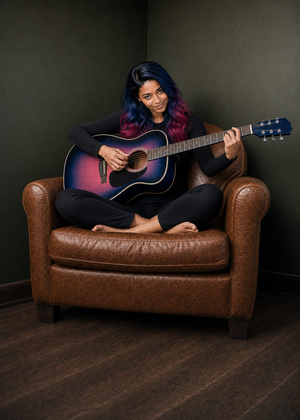
I arrived with a guitar, notebooks, clothes, feelings, and the confidence of someone who had not yet been personally victimised by a utility bill.
So yes, living together again was an adjustment.
When I used to visit her from Watseka, Chicago felt like a preview of freedom. I’d stay for a few days, meet musicians through her, go to shows, walk around Logan Square, and feel like the city was letting me borrow a future. Then I’d go home before the dishes, rent, tired mornings, and real-life parts could ruin the lighting.
Moving in meant I didn’t get to treat her apartment like a backstage pass anymore. I had to become part of the household. I had to contribute. I had to work. I had to stop acting like “I’m writing” was an emergency exemption from basic domestic behaviour.
Mila was loving, but she was not soft about that.
She never made me feel unwanted, but she was clear from the beginning that she was not becoming my substitute parent. She had already done plenty of emotional heavy lifting in our family, and she wasn’t about to let everyone quietly decide that because she was capable, she should carry everything.
I needed that boundary, even when it annoyed me.
Especially when it annoyed me.
Our apartment became this strange little collision of our two lives. Her art supplies, my guitar cables. Her design work, my lyric scraps. Her half-finished paintings, my half-finished songs. She paints women, bodies, rooms, memories — all these layered, personal fragments of life — and I write songs that are basically the same thing with more whining and a capo.
We understood each other creatively, which helped. We could both spend hours chasing a feeling that looked pointless from the outside. She never treated music like a cute hobby. She knew I was serious. But she also knew seriousness didn’t pay rent by itself, which was rude of reality but apparently non-negotiable.
The best part of living with her was the shorthand. Mila knows where I come from because she came from there too. I didn’t have to explain Nana and Pop, or our parents, or the weird ache of loving people who were not always good at staying. I didn’t have to turn my childhood into a TED Talk before she understood why something hurt.
But living together also meant we couldn’t hide from each other.
She saw when I was pretending to be fine. I saw when she was exhausted. She called me out when I got dramatic. I called her out when she tried to act like needing help was a moral failure. We were sisters, roommates, witnesses, and occasionally two women having a silent war over counter space.
Very mature. Very evolved. Basically Scandinavian.
What surprised me most was that we had to get to know each other again. I had spent years thinking of her as my big sister in Chicago, the person who had escaped first. But up close, she was more complicated than that. She was an artist trying to keep painting while working as a graphic designer. She was independent, but tired. Generous, but not limitless. Protective, but trying not to smother me.
And I was not the little kid she left behind.
I think part of me wanted her to see that immediately. I wanted her to know I had grown up, that I could handle myself, that I wasn’t just arriving with a suitcase full of problems and a dream held together by eyeliner. But of course, growing up is not something you announce. You prove it in boring ways. Groceries. Rent. Showing up. Doing the dishes before the emotional monologue begins.
Chicago gave me space to become someone new, but Mila gave me the place to start.
That matters.
Without her, I don’t know if I would have made the move when I did. She was the bridge between Watseka and the life I wanted. Not because she made it easy, but because she made it possible. There’s a difference.
Living with Mila again was not always smooth, but it was real. It taught me that love is not just comfort. Sometimes love is a boundary. Sometimes love is someone saying, “I believe in you, but I am not cleaning up after your potential.”
Honestly, fair.
I came to Chicago chasing music, independence, better players, bigger rooms, and the chance to stop being the version of me Watseka already knew.
But before any of that could happen, I had to learn how to live with my sister again.
Not as the little girl she left behind. Not as the dramatic younger sibling visiting for a weekend. As myself.
Still messy. Still ambitious. Still learning where the mugs go. But here.
Anni x