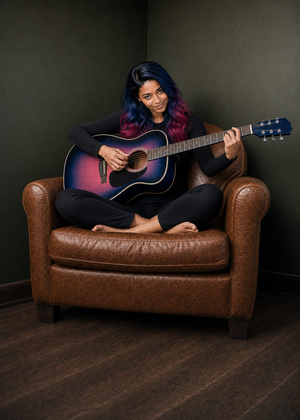
Learning To Be Political
I grew up in a Democrat family, but I wouldn’t say I grew up political.
Not properly.
Nana and Pop had values. They believed in fairness, decency, hard work, looking after people, and not trusting anyone who talked too much about being a “self-made man.” My family leaned Democrat in that ordinary Midwestern way where politics lived in the background — on the news, in passing comments, in someone muttering at the TV while dinner cooled down.
I knew which side my family was on. I just didn’t always understand what it had to do with me.
That sounds naïve now, because politics was already part of my life before I knew how to name it. I’m mixed-race. My maternal grandmother was Black, my maternal grandfather was Native American, and my family also carries German and Irish roots. That isn’t a fun fact I keep in my pocket for interviews. It is my bloodline. It is family history, survival, silence, pride, confusion, and people asking questions they sometimes thought were harmless.
“What are you?”
“Where are you from?”
No, where are you really from?
I’ve always liked answering, “Illinois.”
Because it’s true, and because it annoys the right people.
I’m from Watseka. I’m from back roads, old houses, horses, Nana’s cooking, Pop’s quiet moods, flat fields, bad weather, and the kind of Midwestern stubbornness that should probably require a permit. But growing up mixed in a mostly white town meant I learned early that people could be kind and still make you feel watched. They could mean well and still make you feel like you owed them an explanation.
I didn’t call that politics when I was younger.
I just called it being tired.
Chicago changed the language for me.
When I moved there, I started spending time with people who talked about politics like it wasn’t optional. Musicians, artists, venue workers, legal assistants, activists, queer friends, people dealing with rent, healthcare, racism, immigration, bad bosses, bad cops, and laws written by people who would never have to live under the sharpest end of them.
That was when I started to understand that politics wasn’t just elections.
It was who felt safe walking home. Who got believed. Who got watched in shops. Who could afford a doctor. Who had papers. Who didn’t. Who was allowed to be angry. Who was told to calm down before anyone asked what happened.
Very chill realisation. Great for sleeping.
I didn’t suddenly become some policy genius. I am still capable of reading half an article about constitutional law and needing to stare out a window like a Victorian widow. But I started paying attention. Really paying attention. I asked more questions. I listened better. I stopped treating “I’m not really into politics” as a personality trait and started seeing it as a luxury not everyone gets.
Trump made that even clearer.
By the time ICE, the No Kings demonstrations, and the general feeling of America tilting into something uglier were everywhere, staying neutral felt impossible. I went on marches. I got louder. I got angrier. I also got more careful with that anger, because shouting is easy and understanding is harder.
That period fed songs like This Is Not Normal, We Still Breathe, We Don’t Know How To Save The World, and Not My Apocalypse. I didn’t write them because I suddenly wanted to become a protest singer in the neat, old-fashioned sense. I wrote them because the feelings had nowhere else to go.
Fear. Shame. Solidarity. Exhaustion. The stubborn little spark that keeps people showing up anyway.
Then life did what life does and got personal again.
After Brad broke up with me, I wasn’t mainly writing about democracy. I was writing from the bruise closest to me. I Made It Weird…Again, Ghosted, Too Self Aware To Be Happy, I Knew You’d Do That — those songs came out of heartbreak, embarrassment, overthinking, and trying to make myself laugh before I fully fell apart.
That doesn’t mean politics stopped mattering. It just means heartbreak is rude. It will interrupt a constitutional crisis to ask why someone hasn’t texted back.
Now I’m in London, and politics has come back into focus from a different angle.
Being American outside America is strange. People hear my accent and sometimes there’s a pause. Not because London is shocked by foreigners — London is full of everybody — but because America is loud in the world, and right now a lot of that noise is humiliating.
People here really dislike Trump, and I understand why. I dislike him too. I feel embarrassed by the cruelty, the cheating, the constant performance of power, the way everything becomes about him even when it should be about people’s lives.
The World Cup red-card mess was one of those moments that made me feel ashamed from across the ocean. Sport is supposed to have rules. That’s sort of the point. Watching power bend the table and then call it fairness felt familiar in the worst way.
Living here has made me realise that loving where you come from and being ashamed of what it’s doing are not opposites. I love Illinois. I love the music, the landscapes, the humour, the stubbornness, the people who raised me. But loving your country does not mean clapping while it acts badly.
Actually, I think love should make you less willing to clap.
I’m still learning how to be political. I don’t want to become someone who turns every conversation into a lecture. Nobody invited me to be a one-woman panel discussion with eyeliner. But I also don’t want to hide behind softness when something needs saying.
The personal songs are still political in their own way. Who gets to love safely is political. Who gets believed is political. Who gets asked “where are you really from?” is political. Who gets to move through the world as complicated and still be treated as fully human is political.
I used to think politics was something outside me.
Now I think it was there the whole time.
I just had to learn how to hear it.
Anni x